Listening Session Recap: Part 1 of 7

It’s been over twelve hours since the Bishop’s first listening session concluded and I’m still processing it. Despite the fact that this was a gorgeously sunny Saturday in Buffalo, I’ve been feeling uncharacteristically melancholy all day. The listening session was a very unsettling experience for me. Here is the best recap I can muster:

  • The event was MC’ed and led by Stephanie Argentine, the lead facilitator for the Movement to Restore Trust (MRT). As she expressed it, “we thought I’d just continue the facilitating I’ve been doing.” She explained the general purpose of the MRT and noted that they have 150 active members while 400 people have attended the sessions they’ve held with over 1,000 following their work.
  • From the start, Stephanie made it clear that this was “not an open mic or town hall type meeting.” Instead, the format was as follows:
    • Each table was asked to discuss among themselves their concerns, their suggestions for Bishop Malone and diocesan leadership (“how can Bishop Malone in particular best help or assist us collectively with this crisis?”), and their hopes for the future. After a roughly 25-minute period of “table dialogue and discussion,” each table was to select a representative to “report out” to the entire group. The table reps were given 2 minutes to present their table’s thoughts. There was a “red, yellow and green” time tracker that Stephanie used at the podium.

time tracker.jpg
Amazon advertises this as a tool to “keep kids on task”
    • After the table presentations, the mic was passed by Kathy Spangler to roughly 10 people who raised their hands when the opportunity to speak individually was provided. This was not a scheduled part of the event. After the first round of tables “reporting out,” we were supposed to do a second or even third such round. We just got through the first round at 11:05 with the event set to conclude at 11:30. I believe the random, unscheduled “individual comments” segment was thrown in to give the Bishop time to prepare his remarks and so that he would not have to speak for longer than the 10 minutes allotted for him “to share what he’s heard.*”
    • Then Bishop Malone spoke for exactly 10 minutes. He took no questions and answered none that had been raised. He blessed the assembled and then Fr. Leon Biernat, pastor of St. Greg’s, offered a closing prayer.


  • The St. Greg’s Ministry Center was set up with 24 tables of 8 chairs with roughly 20 of them close to if not full. At least 75% of the group was middle-aged or certifiably vintage.
  • Bishop Malone sat at a table at the front of the room behind the microphone and podium. He was joined by a “panel” comprised of John Hurley (Canisius College President and MRT founder), Dennis Mahaney (Diocesan Director of Evangelization and Parish Life), Tom Beecher (MRT founder and personal friend of Bishop Malone), and an older gentleman whose name I am not 100% certain of so I won’t use a name. The panel contributed nothing during the entire event other than to provide the Bishop with moral support and older white men with whom to sit**.
  • Father Ryszard and Father Peter Karalus were present at the event, but did not participate formally (I noticed that Fr. Ryszard sat at a table and participated in their discussion – I assume Fr. Peter did the same, but did not see him doing so). I did not see Bishop Grosz at all and thus assume he was not present because he is not in the habit of attendance without attention.
  • There were more than a few Catholic Center staff there including Steve Halter (The FBI Guy), Kris Connell (Communications), and Rick Suchan (Foundation) among others. Rick spoke for his table, which I was a little perturbed by but had to acknowledge that as a St. Greg’s parishioner, he should be able to speak as such. I did wonder, however, whether he could effectively separate his diocesan employment from his parish membership. Another diocesan employee said nothing, but called out loudly in defense of the Bishop when someone was speaking critically of him.


  • The most notable element of the morning was the tremendous polarization of the assembled group:
  • Some people were pandering to the Bishop as evidenced by these verbatim quotes:
    • “Thank you for being here with us, Bishop”
    • “Thank you for what you have done for us, Bishop Malone”
    • “Pope Francis has asked bishops to smell like their sheep and that’s what you’re doing today, Bishop”
    • “We love our Bishop!”
    • “Thank you, Bishop Malone, for staying in your position and not running away, but instead staying and taking care of us.”
      • My gag reflex got a good workout during remarks such as these.
  • Other participants were respectfully yet forcefully demanding action, accountability and/or resignation from the Bishop. At one point, a speaker made a distinction between “loving comments” as opposed to “angry ones.” I’ll take righteous anger over unctuous love any day.
  • Here are some of the comments that were expressed during the “report out” segment*** – bolded comments were notable ones in case you don’t want/have time to read them all:
    • We don’t need to restore trust – that’s what got us in this mess in the first place. The problem is that we trusted too much. We need to restore accountability!
    • Abuse must be reported as crimes
    • Bishop Malone should meet in a room with survivors to listen and talk to them
    • The sexual abuse scandal was not addressed at parishes – it was too little too late or not at all
    • The Bishop has not been upfront about a lot of things
    • The cover up is the worst part – why lie when the truth will do?
    • Hard to restore trust when truth is not there
    • We feel betrayed, confused, lost, and sad
    • Power and arrogance are a bad combination in the hierarchy
    • Who determines what type of abuse “rises to the level” whereby a priest should be removed from ministry? (Referring to this recent news)
    • We wish there had been a truly open forum today – a different type of format would have showed that the Bishop really wanted us to speak out. The format of this session directs our comments in a certain way and controls how people can speak. 
    • Importance of the role of women within the Church – separating power from ordination
    • All priests should make a public pledge not to hurt people 
    • Training and formation within the Seminary needs to be examined – how are priests being formed?
    • We need to know more about the law enforcement side of things
    • The media is too negative – especially the Buffalo News and the Washington Post 
    • Catholics are embarrassed to be Catholics
    • There should be an outline of what constitutes abuse
    • The Diocese has let the news control us rather than us controlling the news
    • Where are the people under 40 today?!
    • Full disclosure has not been achieved
    • The Diocese is acting like a political party
    • There have been corporate sins of omission and a lack of transparency regarding financial information
    • Seminary education and formation needs to be renovated and the process of admission needs to be overhauled
    • We need fearlessness from the Bishop
    • Support needs to expressed for priests especially those in rural parishes with no emotional support
    • We are the Church – those are our archives!
    • Priests needs more love from Catholics in general and their parishioners specifically
    • The laity needs to be more involved in decision making for the diocese
    • Every priest is guilty until proven innocent. There have been a number of priests accused over the last year – it’s terrible that they have to go through that
    • Negativeness of the media over the last year – Diocese wasn’t prepared to defend itself and didn’t handle media attacks well
    • Think of this like a game of chess – Bishop Malone, you’ve been acting like a pawn moving one square at a time. You are the bishop – you can diagonally cross the board in one move. Is it time to listen or time for action? 
    • We confess the bad things we’ve done to priests – we need to show the same respect to them and accumulate a mountain of forgiveness
    • Do good people do bad/stupid things? Yes. The clergy deserve our forgiveness in return
    • The Church is being run like a corporation – not as the people of God
    • We are losing the youth of our Church because they don’t trust the hierarchy
    • We have not lost our love for God and the Eucharist
    • Our group was saddened when we found each table only has two minutes to speak
    • Absolute power corrupts
    • Many priests lead solitary and lonely lives – has that contributed to the abuse situation?
    • The media makes stories – we shouldn’t trust that the media is representing the truth. We need to be wary of them.
    • I’m angry and disgusted by the hierarchy. Bishop Malone – you’re the boss- do something!
    • I thank the media for exposing what’s been going on because otherwise it would still be going on
    • The Church shouldn’t be investigating itself
    • Nobody is our savior but Christ
    • I would encourage a different format for these listening sessions. Our table had people with very different opinions and it was hard to get synchronized for a two-minute table report.

Bishop Malone began his remarks by thanking Stephanie for “her gifts at effectively and graciously facilitating this type of gathering.” He thanked those gathered for their “comments, candor and courage.” He stated that in his assessment, the two general themes of the comments were 1) concern for victims and 2) tremendous love for the Church.

He noted his desire for collaboration with the laity while saying he “hears the sense of betrayal and lack of trust.” He went on to say that “the Church’s credibility has been shaken due to 50-60 years worth of this.” Bishop Malone quoted from 1 Peter 3:15: “Always be prepared to give an answer to anyone who asks you to give the reason for the hope that is in you.” He encouraged the assembled to focus on and gain strength from their reasons for hope.

Bishop Malone also recognized the calls for transparency and highlighted his work with the MRT, which is “working independently” on these issues. The Bishop stated that he has met with 4 victims over the last 1.5 weeks and noted that this is a regular part of his ministry****. He also admitted that the Diocese needs to “do a lot better at communication.”

The Bishop acknowledged that it was “anxiety-provoking to be here,” but nonetheless he is “looking forward to listening at these gatherings.” He went on to say that “towards the end of summer, I will prepare my remarks in response to what I’ve heard at these sessions. Those remarks will be shared with my consultative bodies (Diocesan Pastoral Council, Presbyteral Council, etc.) and then we will publish and share with the media the concerns raised and my proposed response to them.”

The Bishop made a point to mention the past week’s Priests Convocation, which was “an intense but hopeful and productive” event that “focused on this reality that overwhelms us on the local, national and global level.” “Our friends from the MRT played a huge role in the whole thing” at the convocation.

His closing remarks: “I will get back to you on some of the specifics raised. Dennis has been taking detailed notes for me as I entered into truly listening. I feel your frustration and my own responsibility. I beg your prayers for me as I pray for you. Forgive me my own failures. And now I will offer a blessing…”

Then Stephanie spoke briefly and assured the assembled that the MRT would be taking “these recommendations from today into consideration” and asked anyone with additional comments to write them on the available 3×5 cards so they could be sure to “capture everyone’s input.” She also noted that the Joint Implementation Team (JIT) would be involved in responding to the listening sessions*****.

My perspective:

  • I strenuously disagree with the Bishop’s assessment of the themes of the comments presented. While concern for survivors and love for the Church was wonderfully evident, the primary themes were more along the lines of: 1) criticism of the Bishop and the Diocese and 2) criticism of anything critical of the Bishop and the Diocese.
  • More than a few times, the entire group felt like Congress during a State of the Union address – half of us would clap after one particular remark and then the other half would clap a little while later while the first group remained motionless. The polarization was palpable and deeply unsettling. I often felt physically ill upon witnessing this tangible division.
  • Likewise, the event felt very political. There were those of us who seemed fed up with the system while other folks were defending the system or at least its operators. When a few people were speaking, I wondered what their vested interest in the diocese is. Political, financial, legal, personal?
  • This was the first time I’ve heard the Bishop say something as direct as “Forgive me my own failures.” That line was so startling it made me sit up straight in my chair. This kind of humility has been sadly rare from him. May it not be the last such expression.
  • The format of this event + the media not being allowed = control. Control of what’s said and who hears it. Control is almost always the result of fear. 
    • By its very nature, the format meant that comments were being expressed rather than questions asked. Questions are scary; comments are manageable. You can “capture” comments; you have to answer questions.
    • They said the media blackout was to protect US, but it was clearly to protect THEM. Who’s afraid of the big bad media?
  • It distressed me greatly to witness the polarization of this group of engaged lay people. The members of the laity are currently engaged in a battle to save the soul of our Church. We cannot accomplish this monumental mission if we are divided as was in evidence at this listening session.
  • This was essentially a MRT planned and run event, which is really sad and disconcerting to me. I trust John Hurley as far as I can hurl him.
    • The Diocese’s Communication Director was relegated to Mic Holder while the MRT’s facilitator strode around the room when she wasn’t keeping the kids on task with her stoplight timer. It was so obvious that the MRT was in charge and the Diocese was just following their lead.
  • People still don’t want to accept the truth. They would rather believe a carefully crafted narrative and trust a silver-tongued prelate than reckon with documented truth. My soul aches.


Bishop Malone isn’t going anywhere.

Neither am I.


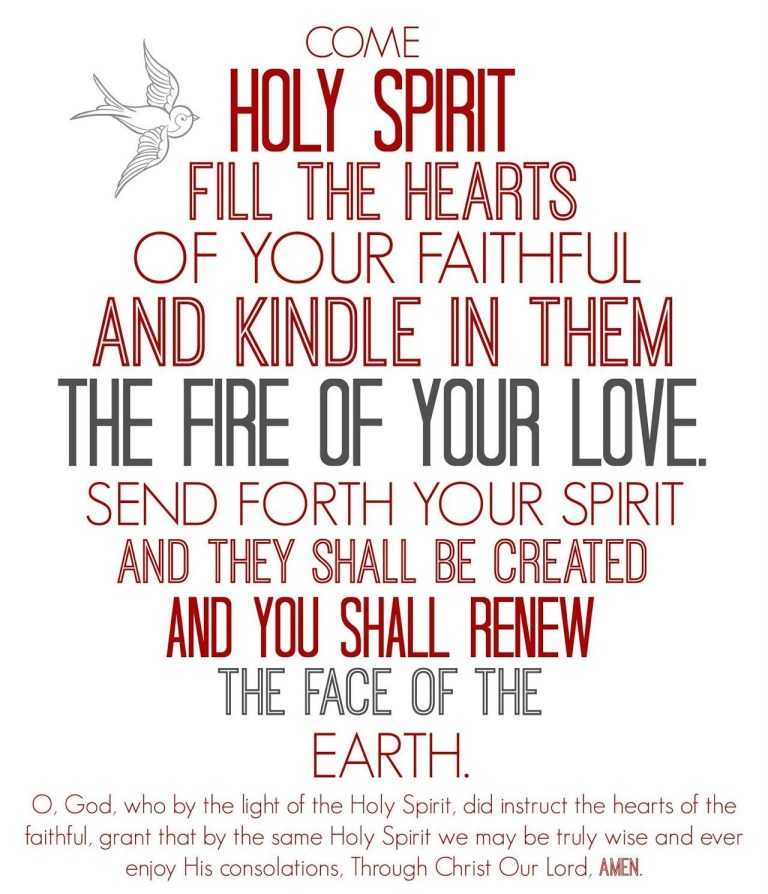
Dear Lord, be near to us and hear our prayers. Save us from ourselves. 
 

holy-spirit-prayer.jpg


* The Bishop is notorious among the priests for padding meeting agendas so that Q&A sections are as brief as possible. He will desperately seek guest speakers so that there’s only a few minutes left at the end for priests to ask questions or express their concerns. I’ve witnessed him do this multiple times for Presbyteral Council meetings and Priest Forums among others.

**Dennis Mahaney took notes so he wasn’t useless. The others literally just sat there. I thought “panels” were supposed to do something. Otherwise why are you getting preferred seating? Cause you’re wealthy and white?

***Comments stated were supposed to represent the collective opinion of each table. They cannot be attributed to any one individual. I took extensive, exact notes so these quotations are verbatim. A quote using the first person pronoun indicates it was stated during the “individual comment” section.

**** It certainly wasn’t part of the Bishop’s “regular ministry” during my three years working for him. To the best of my recollection, he met with no more than 5 or 6 victims during those three years. Two of them were related and met with him at the same time.

***** Phew, the JIT’s on the case. Problem solved. NOT.

Note: I seem to have an acute case of asteriskal snark. 

BF-1

The weather was remarkably windy – the most challenging conditions for protesters. I only managed to hold my two signs up for a few minutes as I feared losing them to the constant gusts.

me and bob for real
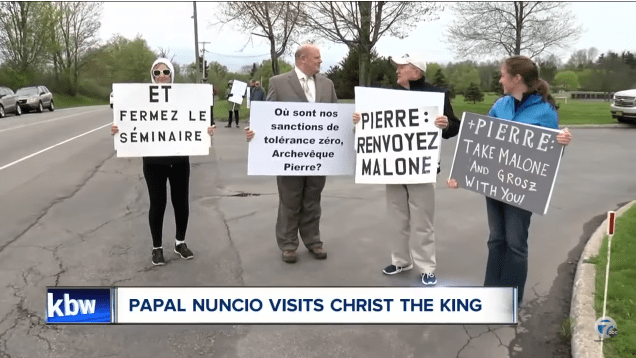
Bob Hoatson’s signs read: “Pierre: Fire Malone” & “And close the Seminary” while Jeff Wick of WKBW-TV keeps watch with his camera

It was nearing 4 pm and we’d been standing by the main entrance of the Seminary for more than a few hours now. We knew the Nuncio had landed at the airport, but weren’t sure when he would be arriving at the Seminary. It was 40 degrees and overcast with winds that nearly blew us over if we were standing at the wrong angle with our signs. I was glad I’d thrown my fleece in my backpack at the last minute or I would have been shivering more than is becoming for a Buffalonian in May.

We were all on the lookout for the Bishop’s black Toyota Avalon as we assumed that would be the vehicle used to transport the Nuncio. The Bishop’s Avalon is best known as “BF-1” since that is the license plate it bears. The Mayor’s license plate is BF-2 and the joke is that if the Diocese is ever negligent with vehicle registration for the Bishop, the Mayor will snag BF-1 from him!

IMG_2195

The Seminary Commencement would begin with Vespers at 4:30 so we knew the Bishop and the Nuncio would have to arrive soon. As 4 pm neared, my fellow protesters would get excited whenever a black vehicle began to approach the Seminary entrance. Each time someone exclaimed about an approaching black car, I would note that it was too high or too narrow, or had the wrong headlights or frame. I was surprised to realize just how well I knew the Bishop’s car.

But then again, I saw it pretty regularly. Not infrequently, the Bishop would have me run down to the Catholic Center garage to grab something from the passenger seat or trunk of BF-1. I would often fly down the stairwell to try and catch the Bishop and Father Ryszard before they left in BF-1. (Both of them have an endearing habit of forgetting necessary items when leaving the Chancery.) Papers, program or phone in hand, I would do my best to flag them down and make the drive-by delivery. I’ve ridden in BF-1 several times to events such as the Mayor’s State of the City Address or the Irish Civic Luncheon. And, of course, I could never forget the epic day last year when BF-1 was stolen right from the Bishop’s garage. It was eventually recovered and the Bishop’s “traveling crozier” was still in the trunk! Bishop Malone ended up getting a brand new Avalon after that, but the BF-1 license plate remained.

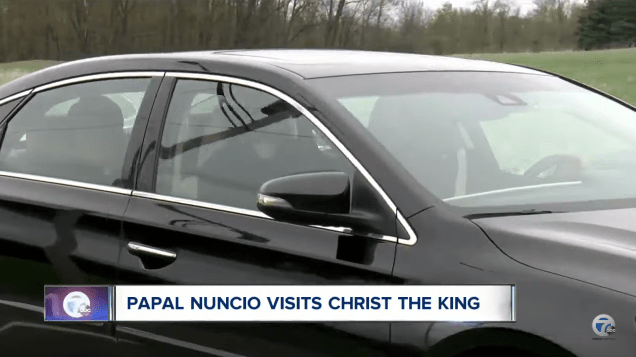
All of a sudden, a black vehicle crested the small hill near the Seminary entrance. “That’s it!” I shouted, “That’s them!” I recognized immediately that this car was of the proper width and height. The angle of the windshield was correct as was its grille. Suddenly they were right there – a mere arm’s length from me as I was the protester closest to the road. Father Ryszard was driving with the Bishop and the Nuncio in the left and right back seats, respectively. A hanger with clothing was hanging near the front passenger door.

BF 1 pulling in

I hadn’t prepared myself for this moment. All of a sudden it wasn’t the wind stinging my eyes – those were tears. This was the closest I’d been to the Bishop since August 21st of last year. I spotted his familiar hair and glasses, but could not see his face or expression clearly. At the same time, I saw my former coworker, Father Ryszard, resolutely driving past protesters and signs to enter his Seminary, which did nothing to protect him from or support him after sexual abuse by a priest. I saw the Nuncio too, but although my sign addressed him directly, he was not my priority in those fleeting seconds. I was focused solely on my former boss and colleague.

How incredibly strange it was to be literally on the outside looking in. I couldn’t help but think of how often I’d called or received a call from the Bishop and Father Ryszard while they were driving in BF-1. “Father Ryszard here” was the familiar, cheerful greeting I would hear followed by: “I’ve got you on speaker so we can both talk to you.” Next I would hear the Bishop’s resonant voice: “Siobhan, we’re just leaving now. Can you call the Cafeteria and ask them to save some lunch for us? We’ll be too late to go through the line.” Then the Bishop and Father Ryszard would begin determining their specific time of arrival. The two of them enjoyed predicting the exact moment: 10:39 am or 2:17 pm, for example. I would laugh at their hilarious precision and tell them I’d be expecting them at 1:42 pm – not a minute before or after. After hanging up, I’d run downstairs to get their usual lunch choices, which I’d bring up to the small conference room for them. I genuinely loved helping both of them and have many fond memories such as this. No matter what came after, we were a fantastic team for several wonderful albeit rose-colored years.

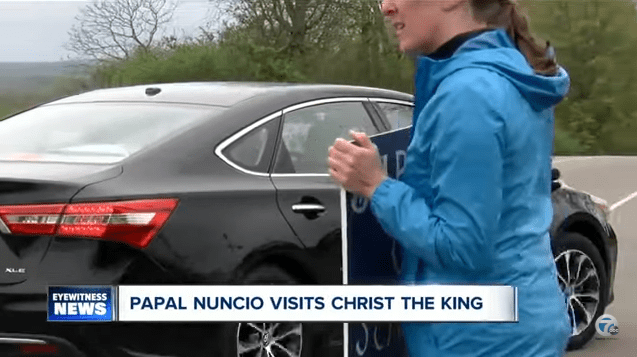
me and bf 1

And now here I was, staring into the windows of BF-1 while holding a sign that read: “+Pierre: Take Malone and Grosz with you.” I was asking the Papal Nuncio to somehow intervene on behalf of our diocese so that our current episcopal leadership could be removed. As much as I believed wholeheartedly in what my sign said, it made my heart and stomach ache to hold it as I did. This was my very first time protesting in Buffalo since all of this began. I protested in Baltimore last November, but have no idea if Bishop Malone ever saw me – the bishops entered and exited the Baltimore Waterfront Marriott in Suburbans with highly tinted windows… we had no clue which bishops were in there and whether they looked our way or avoided us and our signs.

4 of us .png
Jim Faluszczak’s sign read: “Where are our zero tolerance sanctions, Archbishop Pierre?”

But now I was almost positive that Bishop Malone saw my sign – he was mere feet from me and seemed to be looking in my direction. I was purposely standing as close to the road as I could. The lead off-duty cop on patrol at the entrance had already “read us the riot act,” as my Mom would say, about not impeding the path of the Bishop’s vehicle or otherwise causing a disturbance. We had no such intention, but we did want our signs to be read. I believe they were. Bishop Malone is quite proficient in French so he would have been able to easily translate Bob Hoatson and Jim Faluszczak’s brilliant signs. I had tried to mimic a French font for my signs, but Bob and Jim had cleverly used the Nuncio’s native language itself!

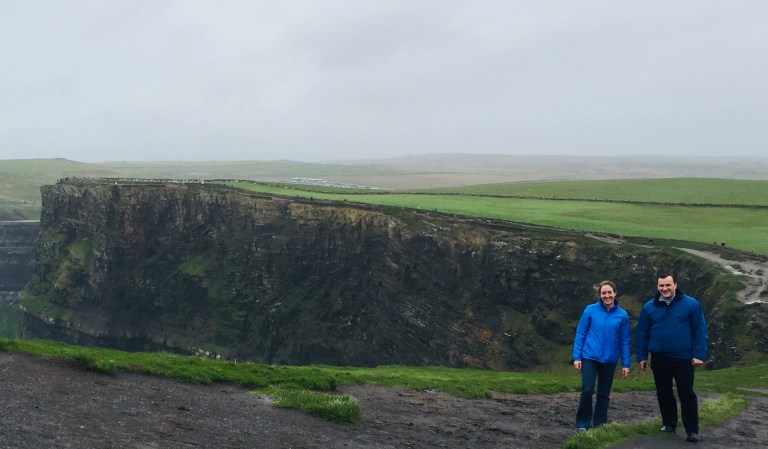
Looking down after BF-1 swiftly passed us by, I smiled faintly at my blue windbreaker. I remembered how I’d bought it before the Ireland pilgrimage I went on with Bishop Malone and Father Ryszard in the fall of 2017. Given that it rained a little bit nearly every day we were there, that windbreaker was my constant sartorial companion. Many of the pilgrims commented that Father Ryszard and I both had blue jackets on all the time. They said we were such coordinated staff for the Bishop. Father and I could only laugh… we were lucky to have the essentials coordinated let alone our attire!

rysz and me at cliffs.jpg
One of my favorite photos from the Ireland pilgrimage – with Father Ryszard at the hauntingly beautiful Cliffs of Moher

The Bishop and Father Ryszard were not the only familiar faces I saw that afternoon. Many diocesan priests and former colleagues drove into the Seminary to attend the Commencement. They had to stop right at the entrance to be checked in by one of the three policemen on duty there. It was an odd procedure to witness: people being elaborately checked in in order to proceed on to the Seminary grounds. What were they so afraid of that they hired private security? I thought to myself. Concerned members of the Diocese? Courageous survivors? The truth? Reality? 

As familiar faces pulled into the driveway, I couldn’t help but notice their reactions to us protesters: a few smiled or waved at me, but the majority looked away or even shook their heads at us. No matter how awkward this is, I remember thinking, I’d rather be on the outside of this operation. I know the Diocese pretty much from the inside out… and as painful as it can be, I’d rather be on the outs than on the inside!

You may be wondering what led me to protest the Bishop and the Diocese for the first time in 10 months. The impetus was the rare visit from the Papal Nuncio to the Diocesan location that has been most on my mind and heart over the past few weeks: Christ the King Seminary. If you are not familiar with the recent and ongoing plight of our Seminarians, you can read about it by clicking on this hyperlink. I wanted to stand in support with our Seminarians – especially the ones who blew the whistle on the recent Pizza Party from Hell at a local parish rectory. I am concerned for those whistle blowers, who were subjected to interrogations as the Seminary and Diocese focused more on who leaked documents than on what those documents revealed. Nothing has changed since this exact same thing occurred last August!

Our Seminarians deserve so much more than they are receiving at Christ the King Seminary. At the very least, they deserve to be treated with respect rather than interrogated. I hope to say more about their plight in the coming weeks. For now, please join me in prayer for the Seminarians here in Buffalo and throughout the world. The global Seminary system needs a major overhaul.

Let me close by noting that no matter how difficult it may have been for me to protest this particular event, I recognize that it is infinitely harder for survivors of clerical sexual abuse to protest in any capacity. I share my protesting perspective as a way to reflect on what this experience was like for me. It still surprises me how emotional this whole situation continues to be. I’ve talked to three new victim-survivors during the past week alone. They are always my priority – it is for and with them that I protest… through bracing wind, startling tears and dispiriting memories.


All screen grabs taken from this video by WKBW-TV courtesy of Charlie Specht and Jeff Wick. My sincere gratitude to both of them for being there with us on Friday.

Holy Thursday: Not Immune to Scandal

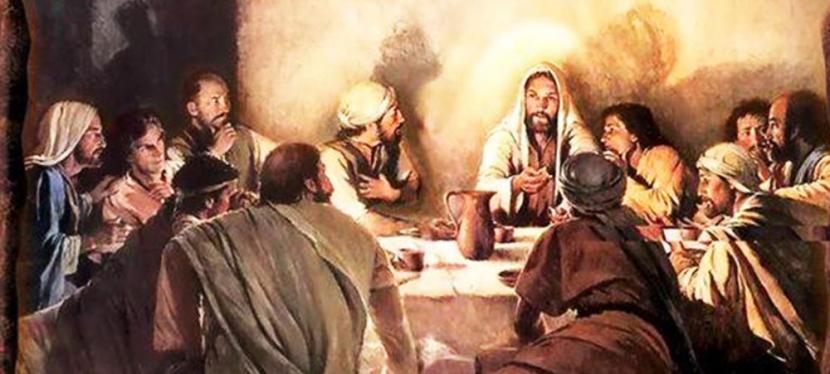
In Matthew’s Gospel, the first Mass begins with a rather chilling revelation: “Amen, I say to you, one of you will betray me.” Jesus is gathered with his disciples in the Upper Room to celebrate the Passover. Before he took the bread and broke it, Jesus warned them that His betrayer was in their midst. Upon hearing this, the disciples were greatly distressed and began to cry out “Surely it is not I, Lord!” According to Luke’s Gospel, this disturbing announcement is following by a debate among the disciples as to “which of them should be regarded as the greatest.” They’ve just been told that one of them will betray their Lord and next thing you know – they’re arguing over who’s the most important! Jesus has to remind them to follow His example as “the one who serves.”

Jesus proceeds to give them another reality check: “This night all of you will have your faith in me shaken, for it is written: ‘I will strike the shepherd, and the sheep of the flock will be dispersed.'” When Peter tells Jesus that his faith will never be shaken, Jesus replies with that memorable warning: “Amen, I say to you, this very night before the cock crows, you will deny me three times.” Not just once will Peter deny, but three times!

Yet despite this full knowledge of Judas’ betrayal and Peter’s denial, Jesus institutes two sacraments: the Eucharist and Holy Orders. He tells them to “do this in commemoration of me” and with these words his apostles now became his first priests partaking in the first Mass. This understanding of the institution of the priesthood was made very clear at the Council of Trent: “If anyone shall say that by the words ‘Do this in commemoration of me’ Christ did not institute the apostles priests, or did not ordain that they and other priests should offer his body and blood: let him be anathema.” The Council Fathers did not mince words on this crucial point!

Of course, these two sacraments are spiritually and practically intertwined so it is fitting that they would be instituted at the same time. Without priests to celebrate Mass and consecrate hosts, there would be no Holy Eucharist. Yet it is fascinating to realize that Jesus instituted these two sacraments at the same time that he predicted the betrayals and denials of the men who were now his priests as well as his disciples.

Not all of the disciples betrayed or denied so dramatically as Judas and Peter. Most of them neither denied nor acknowledged him – they weren’t there to do either. Andrew, James and Matthew, for example, were not questioned by the high priest’s maid as Peter was. Peter “followed at a distance” as Jesus was led to the high priest’s house, which is how he came to be questioned in the courtyard. The other apostles had simply scattered after Jesus was arrested in the Garden of Gethsemane. We don’t know where they went. The shepherd had been struck and the sheep of the flock had indeed dispersed.

We can learn much from pondering the sources of Judas’ betrayal and Peter’s denial. All four Gospels point to greed as the primary motive for Judas’ actions. He is a complex character with likely multiple motives, but greed for those infamous 30 pieces of silver is generally understood as the origin of his betrayal. It is also likely that Judas did not or could not accept that the “kingdom of God,” of which Jesus so frequently spoke, would not be an earthly, powerful kingdom. Judas sought a political – not a peaceful – messiah.  (I could write a post on this topic alone, so I will have to stop myself here.)

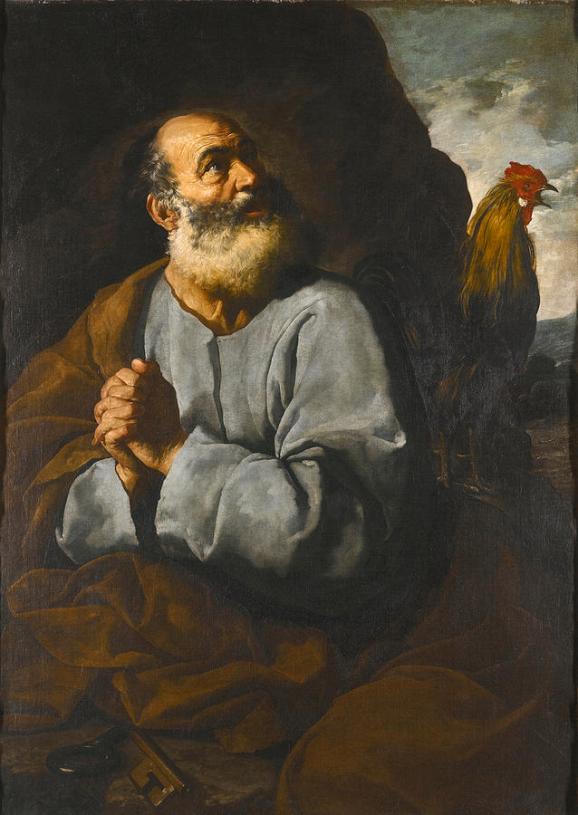
As for Peter, his denials were caused by a lack of moral courage. The Catholic dictionary defines courage as: the virtue of bravery in facing difficulties, especially in overcoming the fear of consequences in doing good. As moral courage, it enables a person to pursue a course deemed right, through which one may incur contempt, disapproval, or opprobrium. Had Peter rejected the temptation to deny Jesus, he would have certainly faced criticism or censure from those assembled in the high priest’s courtyard. In John’s Gospel, the final person to question Peter was a relative of the high priest’s slave, whose ear Peter had cut off not that long ago. The man asked him: “Didn’t I see you in the garden with him?” Now Peter is really under pressure – his questioner was in the garden and, worse, may have witnessed Peter’s violent action, which Jesus remedied with a healing. Mark’s Gospel describes Peter’s third denial in this manner: “He began to curse and to swear, ‘I do not know this man about whom you are talking.'” This was no subtle refutation – it was quite a dramatic denial. Interestingly, Peter does not use his master’s name in his response. The maidservant had used his name “You too were with the Nazarene, Jesus” when she questioned Peter. But Peter cannot bring himself to say that name and simply denies knowing “this man.” The memorable rooster would crow soon thereafter.

peter and the rooster

Reflections such as these automatically make me think of the current leadership of our Church – the bishops who are the direct descendants of the apostles. As we are sadly aware, the hierarchy of our Church is frequently motivated by greed or at least an undue focus on financial matters. They often are more focused on the externals – optics, PR, reputation, titles, etc. – as though their diocese were their kingdom and they must maintain their power and influence over it. Likewise, many of our bishops and cardinals greatly lack the moral courage that is so much needed in these difficult times. And in my experience at the Chancery, the name of Jesus is not heard nearly as much as you would expect. We were all working there because of “this man,” but how little did I hear His Holy Name.

Judas and Peter were two of Christ’s closest companions. They lived with him throughout his three years of public ministry. They witnessed his healings, his miracles, his preaching. They were there the day He multiplied the loaves and fish with enough left over to open a fish sandwich shop. They were there the day He raised Lazarus from the dead. They saw and heard and experienced it all. And still they betrayed and denied while the others scattered in fear. Pope Benedict XVI reminds us that “it is a mistake to think that the great privilege of living in company with Jesus is enough to make a person holy.” Judas and Peter prove that point very poignantly. They also teach us an important lesson for our modern times: “great privilege” in the Church does not automatically lead to personal holiness. In fact, it can often lead in the opposite direction.

But then there’s John, who I have intentionally neglected to mention until now. John is generally considered the youngest of the apostles and was described as “the disciple whom Jesus loved.” John was the only apostle who did not abandon Jesus during His Passion. He stood faithfully at the foot of the cross while Jesus suffered and died. Jesus addressed him directly from the cross with those beautiful words, “Behold, your mother.” From that day forward, John cared for Mary as though he were her son. John offers us a vivid example of love for the Lord, faithfulness in the face of fear, and devotion to our Blessed Mother.

Just as young John must have been a source of great consolation for Jesus during his Passion and death, the young priests of our Church are a source of hope and consolation for us. They are so often filled with great love for the Lord and His Mother. From what I have witnessed or been told, they are remaining faithful to their vows to God and their commitment to His people. They are dedicated to being the “ones who serve” instead of striving for great privilege, lofty titles or plush appointments. This June, eight men will be ordained priests for the Diocese of Buffalo. That is the largest number of ordinands since the year I was born – 1983. What a great sign of hope for our Church!

This Holy Thursday, our Church remains embroiled in a massive scandal related to clerical sexual abuse. But Holy Thursday itself was not immune to scandal. One of Jesus’ longtime followers would betray him in a garden. The apostle who would eventually lead His Church would deny Him three times in a courtyard. The rest of His apostles – save one – would desert Jesus out of fear and weakness. Had there been a Church already present at the time, can you imagine what a scandal this would have been?! Judas was essentially the treasurer for the apostles – the keeper of their collective funds. “Follow the money,” I imagine people would have said. “I knew that Judas guy was shady.” You might have heard people exclaiming: “Peter’s going to be Pope after he denied Jesus three times? What kind of leadership is this?!”

On this Holy Thursday, let us pray for our priests, who give us the gift of Jesus through the Holy Eucharist. Let us pray for our young priests, our seminarians and those about to be ordained. Let us pray for our Church’s leaders – who were priests long before they were prelates. As difficult as it may be, let us pray for abusive priests, whose ordinations imprinted an indelible sacramental character on their souls. Their immortal, priestly souls are in danger. Let us pray for mercy while we work for justice.

Abusive priests have betrayed their God, their vows and their people.

Complicit bishops have denied the abuse, the cover-ups and the relocations.

But unlike most of Jesus’ disciples that Holy Thursday night, we will not scatter. We are His disciples too and we will remain faithful! In the midst of this painful scandal, we will not abandon Jesus despite the sins and failings of some of His ministers. We must stand strong in support of the good priests who far outnumber the bad ones. We must stand in solidarity with each other as we demand moral courage from our Church leadership. And we must be willing to stand at the foot of the cross with the victims of clerical sexual abuse. We must be committed to helping them obtain the help and healing they need to come back from the death of their innocence.


A Prayer for Priests by St. Charles Borromeo

O Holy Mother of God, pray for the priests your Son has chosen to serve the Church. Help them, by your intercession, to be holy, zealous and chaste. Make them models of virtue in the service of God’s people. Help them be pious in meditation, efficacious in preaching, and zealous in the daily offering of the Holy Sacrifice of the Mass. Help them administer the Sacraments with love and joy. Amen.

Stephanie’s Letter

For several reasons, it is not hard for me to recall April 17th, 2018. I remember the snowy, 30-degree weather as I hurried into the Catholic Center that Tuesday morning. Such weather in April is not unfamiliar to Buffalonians, who are accustomed to Second Winter replacing Spring. But that morning, the chilly temps were more notable because I was returning from a visit to a warmer clime. Given the scandal swirling within the Diocese at the time, I had been tempted to postpone or cancel my long-scheduled trip to San Francisco and Yosemite. In the end, I had decided that a 4-day weekend to a beautiful area might be just what I needed.

plane-pic.jpg

By the early hours of Tuesday the 17th, I was beginning to doubt that decision. My flight home had been delayed due to weather, which meant I didn’t make it into Buffalo until 2 am. Due at the Chancery by 8:30 at the latest, I began to mentally prepare myself to return to the Catholic Center running on empty. The Wednesday prior, I had prepared the office for the Bishop’s return from Easter vacation. As these photos indicate, he was greeted by a full counter and a plethora of mail to process. I wondered what would greet me upon my return a week later.

It was now 11:40 am. The preceding 3 hours had been a dizzying blur of emails, voice mails and requests. Grateful that the Bishop was now otherwise occupied, I took a moment to catch my breath at my desk. Father Ryszard must have been waiting for this opportunity because he immediately approached my cubicle. I figured he was going to update me on what had transpired during my absence, but he had only one thing to say: “You should read this.” His expressive eyes told me all I needed to know: the letter he had given me pertained to the abuse scandal and it was going to be a painful read.

I have never been so viscerally affected by the written word. While reading Stephanie McIntyre’s 7-page letter to Bishop Malone, I had to stop multiple times. At least three times to brush away tears, which were blurring my vision and preventing me from reading further. Once to bend over and hope I didn’t throw up on the anti-fatigue mat upon which I stood. By the time I reached the letter’s end, I was sobbing with sorrow for Stephanie while my blood boiled at the thought of her abuser, Fabian Maryanski. Just writing these words brings me back to that seismic moment. It was as though I had survived an earthquake that only I had felt.

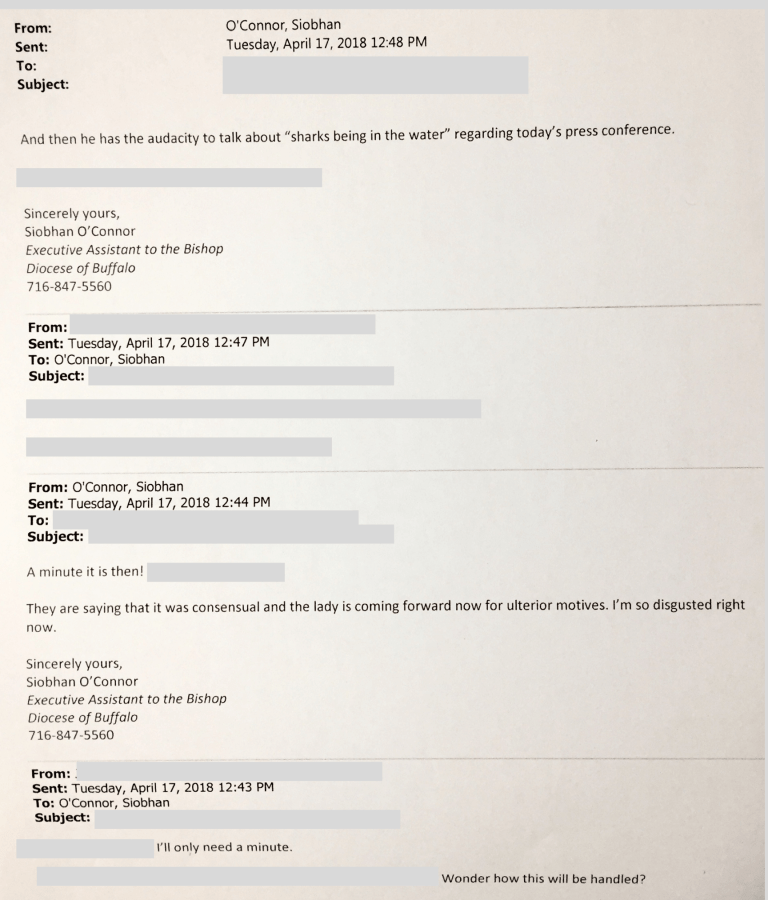
Around 12:20 pm, I realized that I needed to explain my crying fit to my nearest co-worker. Close to me both figuratively and literally, she could see and hear me crying. She was accustomed to my tears during and after speaking with survivors on the phone, but would have had no idea what brought on the waterworks this time. I could not trust myself to speak about Stephanie’s letter yet, which is why I resorted to email. Our email exchange can be found below:

When reading this email thread,

please begin at the bottom of the second image and read up. 

top-email-pic.png

bottom-email-pic.png

This is the first time that I’m sharing the background of my “burn this place down” remark, which was made public during 60 Minutes Overtime last October. How vividly do I recall the moment when Bill Whitaker startled me by reading that line and asking for my comment on it! As the blood rushed to my cheeks, I thought of Stephanie and the intense anger I had felt upon reading her letter. Reviewing this email thread a year later, I winced at the burning and skinning I wrote about a year ago. Those lines make me sound angry and violent. And yet that is how I felt after I read Stephanie’s letter: enraged and wanting to somehow release that rage, which affected me so powerfully. I fear fire and can hardly skin grapes, so I’m no threat as an arsonist or otherwise. But how I burned with anger after reading what had happened to this innocent young girl! Her entire life was traumatically and permanently impacted by a priest’s repeated abuse in every imaginable category: sexual, physical, emotional, psychological and spiritual.

steph-photo.jpg

Stephanie’s story impacted me at a deep level for many reasons, but especially because I could relate to her story as a woman. Hers was one of the first female survivor stories I encountered and certainly the most disturbing in its detail. A few of the events she described made my skin crawl because I could not fathom having physically experienced what she had been made to endure. Other elements of her story resonated with me on personal levels of a different nature. For example, Stephanie described how she rode her bike to Mass to meet her new pastor, Maryanski. Later on, he would give her a new bike among other special, expensive gifts. This mention of bicycles reminded me of how as a kid, I used to ride my bike around my neighborhood so much that an elderly man at the end of the street called me “the bike girl.” Stephanie was Maryanski’s “bike girl”– an innocent young lady who would never be the same after that fateful bike ride to meet her new pastor.

To make matters somehow even worse, I knew that Maryanski had friends in particularly high places:

  • He was a classmate and personal friend of Auxiliary Bishop Edward Grosz
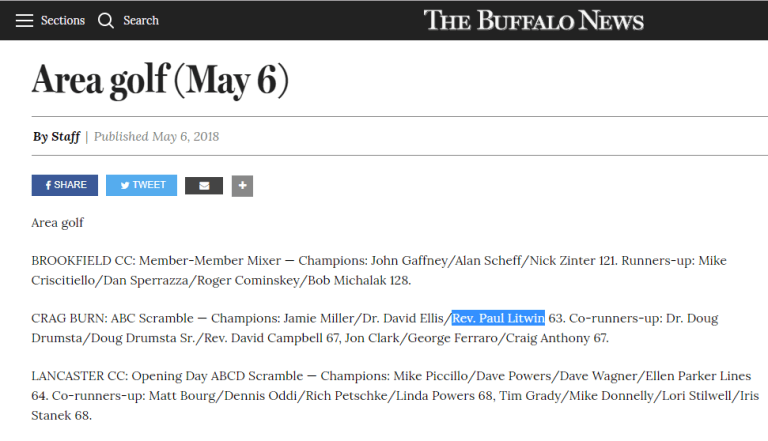
  • He was a golfing buddy of Msgr. Paul Litwin – longtime Chancellor for the Diocese of Buffalo, who had just recently left to become pastor of a wealthy parish
  • He was also a “Thursday night dinner” friend of Msgr. Litwin, who gathered with a tight group of classmates and friends every Thursday evening for cocktails & dinner

I wondered if Stephanie knew this information about her abuser and how his high-ranking friends (and a grossly negligent* Bishop Malone) had protected him all these years.

Although I was highly distressed by Stephanie’s letter, I was grateful to Fr. Ryszard for showing it to me.** I remember asking him these questions about Stephanie’s letter: “When did Bishop Malone read this?” and “What did he do about it it?” His answers were simple: “When it arrived on Friday the 13th” and “He sent it on to Terry and Lawlor.” I knew the Bishop would have read the letter himself – he always did so with correspondence labeled “Personal” and/or “Confidential.” It was important to know that he had read it the same day it arrived. While not surprised to hear that her letter was sent directly to the lawyers, I was extremely disheartened nonetheless. This letter requires a pastoral, personal response – not a legal one! I thought to myself. Here we go again with Bishop Connors and Most Reverend Quinlan. 

stphe-pic.png

It was indeed a legalistic response that Stephanie received in early June. I remember being shocked by just how brief, cold and impersonal it was. Drafted by the lawyers and approved and signed by Bishop Malone, the letter merely mentioned his “sadness” regarding Stephanie’s “history with Fr. Maryanski” and emphasized that Bishop Malone was not in Buffalo at the time. The words “abuse” and “crime” were, of course, never used. There was no personal expression of sympathy or pastoral support. No indication that the Bishop wanted justice for 15-year old Stephanie or appropriate consequences for her abuser’s abhorrent offenses. The letter closed with a stern request that Stephanie cooperate with the Diocese’s investigator.

I was appalled. As I formatted the ugly little paragraph on the Bishop’s letterhead, I thought to myself: How can we possibly send such an awful thing to this brave woman? I remember thinking that this was the worst thing I’d ever cut and pasted onto that familiar cream and green stationery. I was so tempted to humanize those heartless words, but stopped myself as I remembered my recently adopted rule — no more making the Bishop look better than he was. As I folded the letter and prepared to stick it in the envelope, I thought about adding a post-it note that simply read: Someone in this Chancery cares about you and is sorry that you are receiving such a miserable missive. How I wish I had.

Bishop Malone may not have appreciated or respected Stephanie’s courageous testimony, but the people of Buffalo and beyond surely did. Stephanie’s story would be compellingly told by Jay Tokasz of the Buffalo News in a May 6th front page article. The next day, Monday the 7th, I witnessed two unbelievable reactions from Maryanski’s close friends.

It was after 10 am and Bishop Malone and his Senior Staff were in the fourth floor’s large conference room for their regular Monday morning meeting. Next thing I knew, Msgr. Litwin waltzed through the Chancery’s oak doors. He had started at Christ the King Parish about a month before… just a few days after Easter. Monsignor was holding the Buffalo News Sunday edition in his hand and his face was filled with consternation. I could only assume he was distressed by the Maryanski cover story. He was, but not for the reason I expected. This is what he exclaimed to me: “You won’t believe this! My winning golf score is listed in the Sunday paper, but now I can’t ask people ‘Did you see what was in yesterday’s paper?’ because they’ll think I’m talking about the cover story!” Then he opened the paper to show me this mention of his name and score:

golf.png

At this, I was bereft of speech. I have no idea what my facial response looked like, but it was of little consequence since Monsignor paid me no heed while he proceeded to collect his mail and then exit the Chancery. I never uttered a syllable in response to him, but oh the things I said upon his departure!!

After it was determined that Maryanski would be summoned to the Chancery that afternoon and put on Administrative Leave, Bishop Grosz worked with me to prepare the appropriate documentation. I was becoming sadly familiar with these documents, but Bishop Grosz always made sure I had all of the details accurately noted. He was visibly crestfallen as he finalized these documents. At one point he starting shaking his head as he expressed the following sentiments:

“Oh poor Fabe, this will be so hard on him!” 

Again, I was speechless. ‘Poor Fabe?’ Are you freaking kidding me?!!!!! It SHOULD be hard on him – finally!! He got away with this for long enough! Not once had either bishop lamented the damage done to “poor Stephanie.” Not once had they expressed distress over the abuse she had endured or the trauma she suffers to this day. But now “poor Fabe” had to face mild consequences for his crimes and it was suddenly a dark day at 795 Main Street. Bishop Grosz was in quite a frenetic state as he prepared for his friend’s visit to the Chancery. I wondered what Bishop Grosz had done in the past to prevent this very thing from occurring. Now he could no longer save his beloved buddy.

Stephanie’s story went on to become the heart and soul of Charlie’s third report as well as the 60 Minutes report that followed. Without her courageous testimony, we would not have known the full story behind Maryanski, whose infamous entry on the Bishop’s draft list reads as follows: “We did not remove him from ministry despite full knowledge of the case, and so including him on list might require explanation.” Yes, it does require explanation, Bishop Malone, and we are still waiting for that explanation.

I must admit that it has been challenging to write this post. Reliving these specific days last year was more emotional than I expected. Reviewing the emails included above, I recall so vividly how it felt to be “in the pits of despair” at the Chancery. I often felt trapped in my cubicle as if it were a cell… wondering if the air quality in the Chancery had always been this bad or if my inability to take a deep breath was due to psychological factors rather than environmental ones. Wishing that I could do something – anything – to help survivors such as Stephanie.

Eventually I realized there was something that could be done to assist them in their quest for truth and justice. In the process, I was able to “meet” Stephanie via social media. Her gentle demeanor, courageous spirit and deep faith are a tremendous example to us all. I keep trying to express just what Stephanie means to me, but all of my words fall short. She is an indescribably incredible woman. 

Stephanie: ever since April 17th, 2018 you have been a hero of mine. I believe you, I respect you and I admire you. May God reward you – in this life and the one to come – for your strength, your faith and your courage.

superman s.png


__________________________________________


*By “gross negligence” I mean that Bishop Malone was made aware of Maryanski’s history a month after being installed as bishop in 2012 and never properly addressed the allegations against him (and many other abusive priests) or initiated the process of having such cases adjudicated by Rome as canon law clearly mandates.

**Father Ryszard broke no Chancery protocol by sharing Stephanie’s letter with me. We were both authorized to process Bishop Malone’s mail and often saw “Personal/Confidential” correspondence after the Bishop read it. We would be the ones scanning things to the lawyers or otherwise forwarding/handling such letters. Father was sharing the letter with me because I had missed its arrival and he wanted me to be aware of it.

Cover image: A Girl Writing by Henriette Browne – chosen because I imagine young Stephanie encouraging current Stephanie as she wrote her powerful letter to Bishop Malone.

The Saint of the Day

PART ONE

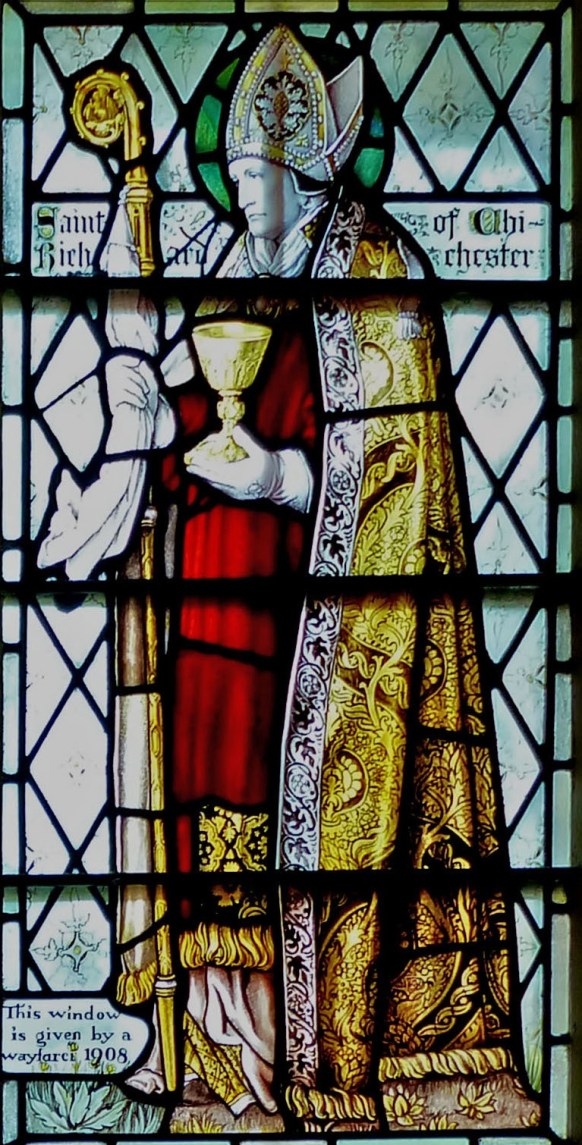
Today is Bishop Malone’s first name feast day. April 3rd is the feast of St. Richard of Chichester, an English saint who takes his title from the diocese of which he was bishop during the first half of the 13th century. Please join me in saying a prayer for Bishop Malone on his special feast.

st. richard.jpg

Bishop Malone told me about his patron early on in my Chancery tenure. Before he left for his annual July vacation that summer of 2015, he showed me a small booklet entitled St. Richard of Chichester by Reverend Henry E. Dunn. The booklet was first published in 1907 and Bishop Malone’s copy seemed to have been printed not long after. It was mostly legible, but no longer bound. The pages fell limp inside the light blue cover. Bishop Malone asked if I might be able to copy the pages and assemble them into a new booklet. There was an altar boy named Richard who served at the Cathedral and Bishop Malone wanted to share this biography of their mutual patron with him.

Looking at the booklet after Bishop Malone departed for the Cape, I immediately noted that the pages were not going to copy well if at all. At 32 pages, the relatively small booklet would be better re-typed than copied. Thus I began typing three or four pages a day during the weeks the Bishop was gone. Before he returned, I printed the new booklet with a cardstock cover that included a color image of the saint. I still remember Bishop Malone’s expression of delighted surprise when I showed him the finished product. I was thrilled to have helped him in this way. (I say this not to praise myself, but to demonstrate how much Bishop Malone loves his patron saint and how eager I was to do anything I could for the Bishop.)

One happy result of typing up a saint’s life story is that you are not likely to forget it! Here are some highlights of St. Richard’s life:

  • He was a gifted scholar and canon lawyer
  • As bishop, he personally visited the sick, attended to the poor and buried the dead. At one point his steward voiced concern that the bishop’s almsgiving was greater than his means. To this St. Richard replied by telling the man to sell some of his (St. Richard’s) belongings including his horse.
  • According to legend, he once accidentally knocked over the chalice while celebrating Mass. However, not a drop of the Precious Blood was spilled, which is why a chalice is one of the symbols associated with this saint.
  • He foretold his own death

All of these are noteworthy, but it is this description of St. Richard that is most incredible to me:

“In maintaining discipline St. Richard was inflexible, especially in chastising crimes in the clergy: no intercession of the king, archbishop, and several other prelates could prevail with him to mitigate the punishment of a priest who had sinned against chastity.”*

Wow. You canNOT make this stuff up, my friends.

This element of Saint Richard’s life reminds us of an important point: clerical sins against chastity are not a modern phenomenon. St. Richard lived from 1197-1253… a reminder that sins of this kind are nothing new. While St. Richard would be familiar with the sins that we are sadly aware of in the Church today, he would not relate to the cover up and conspiracy that have surrounded these sinful actions. St. Richard himself would never have stood for such a response to clerical misconduct of this nature. Neither would the pope who reigned during much of St. Richard’s lifetime.

innocent III.jpg

Pope Innocent III was a brilliant pontiff who “conquered heresies, clarified Church doctrines, corrected clerical abuses,” and sanctioned St. Francis of Assisi and St. Dominic to continue their respective reforms and ministries. In St. Francis and St. Dominic, Pope Innocent saw a powerful antidote to the vices which were plaguing the clergy at that time. During his 18-year reign, Pope Innocent authorized his papal legates to “deprive all unworthy clergy of their benefices [revenues due from their ecclesiastical offices] and there was no right of appeal.”*

How greatly does our Church need bishops such as St. Richard and a pope of Pope Innocent III’s caliber! Their moral discipline, moral courage and moral clarity plus their ability to effectively reform are sorely lacking at this time. On this feast of St. Richard, let us pray that God might inspire all of our bishops – especially Bishop Richard Malone – to act with the fortitude and conviction which marked every aspect of St. Richard’s life but especially clerical reform.

The following prayer of St. Richard of Chichester was made popular by the play Godspell where the words can be found in a song called “Day by Day.” 

Thanks be to thee, our Lord Jesus Christ,
for all the benefits which thou hast given us,
for all the pains and insults which thou hast borne for us.
O most merciful Redeemer, Friend, and Brother,
may we know thee more clearly,
love thee more dearly,
and follow thee more nearly.    Amen.

_______________________________________________

PART TWO

Thinking about the “saint of the day” brings back many fond memories from my time at the Chancery. One of my regular duties there was to create and type the Bishop’s agenda for each day he was in the office. As I became accustomed to creating the agenda, I began adding “the Saint of the Day, pray for us” underneath each day’s date. This was a natural instinct of mine due to my upbringing. My wonderful Mom began every day of homeschooling with the appropriate reading from Saints for Young People for Everyday of the Year, a two-part series by the Daughters of Saint Paul. My siblings and I loved learning about our heavenly friends whose stories were filled with such fascinating details, heroic achievements and compelling holiness. We eventually branched out into Butler’s Lives of the Saints, which is considered the authoritative work on the subject, and many full biographies of individual saints.

Thus it surprised me when my “saint of the day” practice became such a remarked-upon addition to the Chancery routine. At least once a week, one of the Chancery bishops or priests would comment about a saint’s name. Usually they expressed surprise as they hadn’t heard of that particular saint. Sometimes they even questioned whether the saint was real or not! Well do I recall my debate with Monsignor Litwin as to whether St. Lidwina was a legitimate historical figure. (She most certainly is and she’s awesome!) When I told Bishop Malone the saga of St. Dymphna’s life, he was staggered by it and immediately called across the room to Bishop Grosz and Monsignor Slubecky: “Ed, David- you’ve got to hear this story!”

Bishop Malone frequently commented on my saintly selections and more than once noted that I was “giving the Chancery a lesson in hagiography.” I began to have a little fun with the practice and started to include some truly unusual saints when there was no “standard” saint assigned to a date. I particularly recall Sts. Ewald the Dark and Ewald the Fair whose feast is in early October. These two missionary martyrs shared the same name and were thus distinguished by the color of their hair. I can still hear Monsignor Slubecky’s robust laugh when I explained the saints of the day to him!

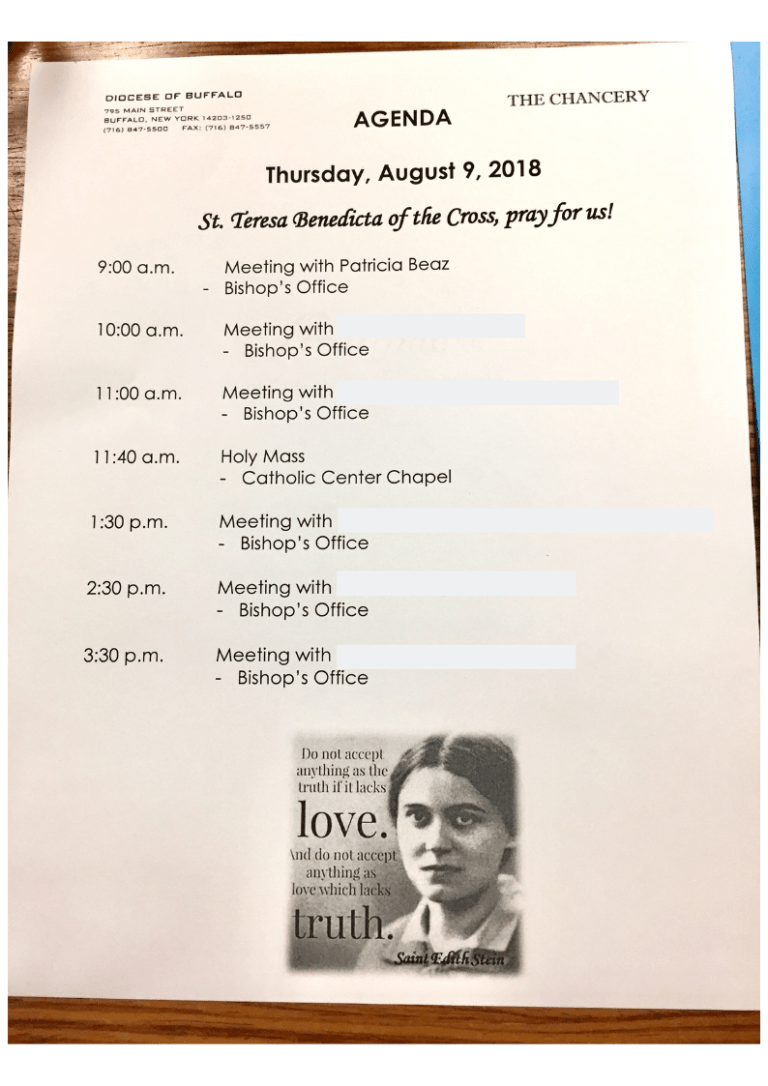
I don’t have many pictures of the Chancery because it never occurred to me to take photos of my workplace while I was actually working there. How I wish I’d taken a photo of the infamous vacuum closet wherein I discovered the notorious black binder! But I did take a photo of the final agenda I created. It was dated August 9th. My last official day was Friday the 10th, but I didn’t create an agenda that day because the Bishop took off on Fridays.*

last agenda.png[I maintained the name of the individual who had the first appointment that day since that person was my eventual replacement, Patricia. I remember how happy I was when her interview with Bishop Malone was successful and he determined that she would be the one to take the position. As it was my next-to-last day there, I was quite relieved!]
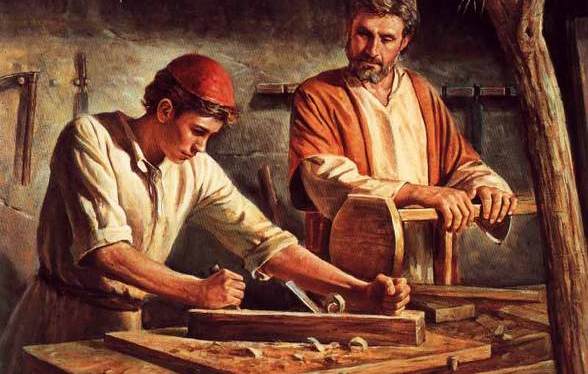
A wave of nostalgia came over me that morning as I surveyed the Bishop’s counter, which was attached to my cubicle. Bishop Malone did most of his work while standing at this counter. He would peruse the mail, jot notes to staff, review various materials, check his calendar, and collect any items he needed for evening events. When I think of Bishop Malone, I imagine him standing at this counter where I interacted with him countless times over the years.

Looking at this familiar counter for the final time in an official capacity, I took a photo of it:

last day counter.jpg

Here’s what the Bishop’s counter looked like that last day… and every day beforehand. There’s the Bishop’s mail at the far end of the counter. Beyond the wooden mail tray are the Diocesan coat of arms flags, which I had prepared for the Bishop’s new residence. They’re the white items wrapped in plastic.

The traffic signal colored folders contained the materials the Bishop would need for the various meetings on his agenda that day. The red folder next to the agenda contained information pertaining to the letters to Cardinals Dolan and O’Malley, which were my last drafting assignment from Bishop Malone. The oft-used “To Be Signed” blue folder contained the final versions of those letters for his signature. At the forefront of the photo, you can see part of the “office toolbox” I set up for the Bishop’s use… letter opener, paper clips, stapler, white out, post-it notes of all sizes. The bright pink post-it notes you see contained the names of Bishop Malone’s key staff. We designed them so that all he had to do was check a name and attach the post-it to a document, which I would then send off through inter-office mail.

The silver base of my standing desk is visible on the lefthand side of this photo and shows just how closely Bishop Malone and I worked. We were literally within an arm’s length of each other!

There are also the plastic bins that you can see peeking out from under the counter. I used them to store items which needed to be filed. I learned pretty early on that it wasn’t a good idea to file items too quickly because oftentimes the Bishop or other Chancery staff would need to review a document more than once and it was helpful to have such items near at hand. Always one to attach significance to colors, I designated the bins as follows:

~ The blue one contained all documents pertaining to the priests and deacons for blue is Mary’s color. I prayed that our Blessed Mother might intercede for the men who had generously devoted their lives to ministry within her Son’s Church.

~ The green one was for “people, places and things” because green is my favorite color and also the color of hope and harmony the latter of which I always strove to achieve in responses related to disgruntled people, challenging places or hapless things.

~ The orange one was for the Archives because orange is my least favorite color and I hated the Archives… for obvious reasons.

And there you have it – the memories that come back to me when I think of my “saint of the day” experiences in the Chancery. Despite all that has occurred since my last day there, these memories bring a smile to my face. It even makes me laugh to recall how often Monsignor Slubecky would emerge from his office waving an agenda and exclaiming something along the lines of: “St. Gosbert’s feast day is finally here – I’ve been waiting for it!”

God rest your soul, Monsignor.

God help our diocese.

May the saints of all the days intercede for us! 


*In case you can’t quite believe that quotation about St. Richard, you can read the online biography from which it was pulled.

*In fairness to Bishop Malone, I should note that his weekends were almost always filled with several Masses and other events. Thus he did not have Saturdays and Sundays off as people usually do and his taking Fridays off was an appropriate practice.

*Quotations in this paragraph were taken from this article.


The Silent Ones

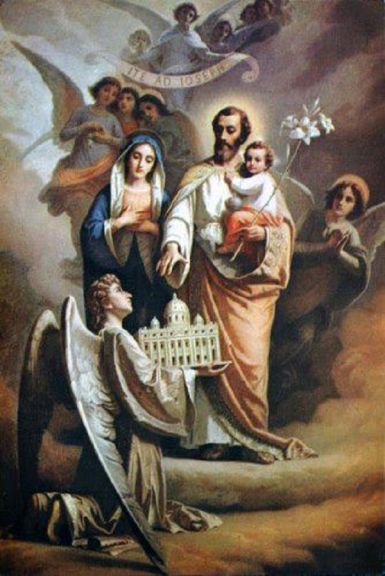
Today is the Feast of Saint Joseph, the foster father of Jesus. It is also Bishop Malone’s birthday- his middle initial “J” stands for Joseph. While I still struggle with Bishop Malone’s leadership (or lack thereof), I am praying for him on his birthday. The bishop is fortunate to have St. Joseph as one of his special patrons. This great saint is also the patron of our Diocese and of the Universal Church.

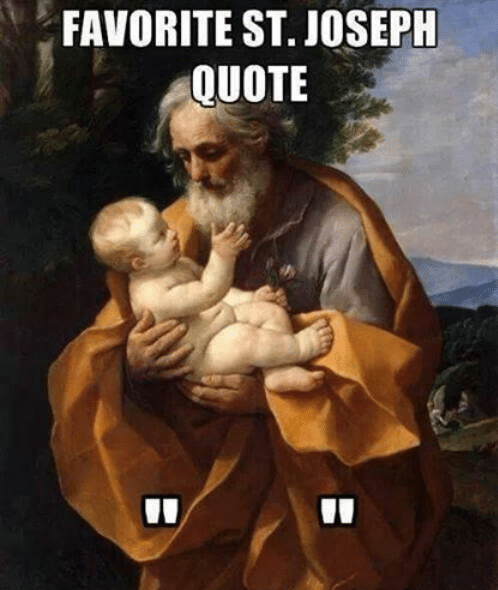
For being such a crucial figure within the life of Christ, St. Joseph is a surprisingly silent one. Not once in the four Gospels is St. Joseph recorded as saying anything. He is perhaps the greatest example of that old adage: actions speak louder than words. This “righteous man,” as Matthew’s Gospel describes him, did everything that God asked of him including taking a pregnant Mary as his wife and making a perilous escape to Egypt. No matter what the Holy Family was facing, St. Joseph was there to provide for and protect them.

st-joseph-quote.png

As much as we would treasure a few quotations from St. Joseph, it makes sense that he is a silent figure in the Gospel story. After all, Mary doesn’t have that many quotations in Scripture either. Just as Mary “kept all these things, pondering them in her heart,” so to did Joseph have a lot to ponder. The Angel of the Lord appeared to him several times during dreams in order to convey divine directions. Such dreams must have been startling to say the least! Within a relatively short period of time, St. Joseph lovingly accepted a pregnant wife, traveled to Bethlehem and sought shelter in a stable when no other lodging could be found, made a hasty and hazardous trek with his family to Egypt, and later he and Mary lost their divine Son for three days. That’s a whole lot to ponder!

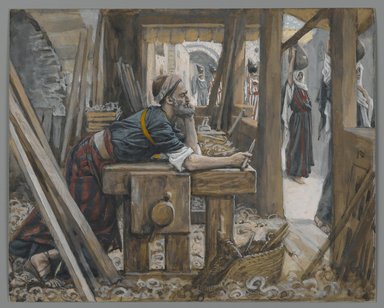
st. joseph anxiety

The Anxiety of Saint Joseph, James Tissot (French, 1836-1902)

St. Joseph offers us a beautiful example of one who listens more than he speaks and contemplates more than he communicates. St. Joseph was a man of silent strength – a valuable combination that our world so greatly needs. In his book The Power of Silence: Against the Dictatorship of Noise, Cardinal Sarah beautifully notes that “there is no place on earth where God is more present than in the human heart. This heart truly is God’s abode, the temple of silence.” St. Joseph seems to have lovingly cultivated the presence of God in his “temple of silence.”

Reflecting on St. Joseph’s silence led me to consider silence of a different nature. So many victims I’ve encountered or learned of are still suffering in silence. For many, they are not at a point in their journey where they are able to speak about the abuse they endured. Still others can speak no more – their lives were ended by drug overdoses or suicide when the pain was too great to bear.

Silence is not golden

There are other silent victims we rarely hear about: the parents, siblings and spouses of victims. It is hard to fathom the grief that these parents experience. Can you imagine entrusting your beloved child to the care of a priest only to discover years or decades later that this “man of God” raped your son or daughter? What anguish they must experience! I’ve spoken to many parents who are racked by a guilt they struggle to escape. I think of the single mother who was overjoyed when the smiley young priest took an interest in her son – the only boy among several sisters. When she found out what the priest did to her son, she tried to warn the parents at the new parish the abuser was sent to. She couldn’t believe he was assigned to another parish with a school! She is consumed by guilt over her son’s abuse as well as the fear that other children suffered a similar fate.

What if your sibling was abused by a priest? Perhaps they’ve just told you this recently. This news explains some of the challenges your sibling experienced… how they changed at a certain age and never returned to their “usual self.” You wish there was something you could do to help, but your sibling is tangled in a web of addiction and rejects every helpful attempt from you. Other people have experienced even greater trauma when their abused sibling became their abuser. This tragic occurrence happens more often than we would like to think. The cycle of abuse is indeed vicious and so many innocent souls can become caught up in it.

Then there’s the spouse of a victim, who suffers along with their husband or wife as they struggle to free themselves from the trauma of their past. A spouse is there when another nightmare leaves their loved one weeping at 2 am. Or when a memory temporarily renders them immobilized by pain. How their hearts must break to watch their loved one suffering and not be able to stop the pain entirely. Hopefully they know how much their loving presence means to their spouse. Many survivors have told me that they would not have survived various traumatic episodes or experiences without the support of their spouse of other loved one.

So this St. Joseph’s Day, I am thinking of and praying for all victims of clerical sexual abuse – those who have identified as such and those who may always suffer in silence. I hope that they all know how many people support them and pray for them.

I especially love the closing lines of a prayer to St. Joseph, which was composed by Pope Leo XIII:

As once you rescued the Child Jesus from deadly peril,
so now protect God’s Holy Church
from the snares of the enemy and from all adversity;
shield, too, each one of us by your constant protection,
so that, supported by your example and your aid,
we may be able to live piously, to die in holiness,
and to obtain eternal happiness in heaven. Amen.

God’s Holy Church is currently ensnared by a great deal of evil. May St. Joseph, patron of our Universal Church, intercede for us in a profound way right now. And may he who knew silence so well be present to all those who suffer in silence.

st josehp universal church


Meeting Michael

Even as a child, I was never one to use the word “hero” lightly especially when applied to living persons. Fascinated by Greek mythology and inspired by Christian hagiography, I had developed very high standards for heroism. While I certainly appreciated that people could display heroism or have heroic moments, I was reluctant to bestow the title of “hero” on anyone.

Until February 27, 2018.

It was a Tuesday. A memorably bright and sunny one. The sunshine made it so you almost forgot it was winter in Buffalo until you stepped outside and felt February. It was a busy morning at the Chancery. In just two days, Bishop Malone would be holding a press conference to announce that the Diocese of Buffalo was initiating an Independent Reconciliation and Compensation Program (IRCP). These were the final days of preparation for this major and historic announcement. The previous Thursday, Bishop Malone had asked me to email all of the priests of the Diocese to inform them of a meeting with him. The meeting would be held at a local parish right before the press conference took place at the Catholic Center. The Bishop, along with his Senior Staff and legal team, was focused on gearing up for this priest meeting and the subsequent press conference.

The hustle and bustle of the morning was interrupted with word that there would be a press conference held around noontime outside of St. Louis Church (across from the Catholic Center, the headquarters of the Buffalo Diocese). A victim of a diocesan priest would be speaking out about the sexual abuse he had endured. This was startling in two ways. First, that a victim would be speaking out in such a public manner, which was without nearly any precedent. Second, that this press conference would occur a mere two days before the Bishop’s.

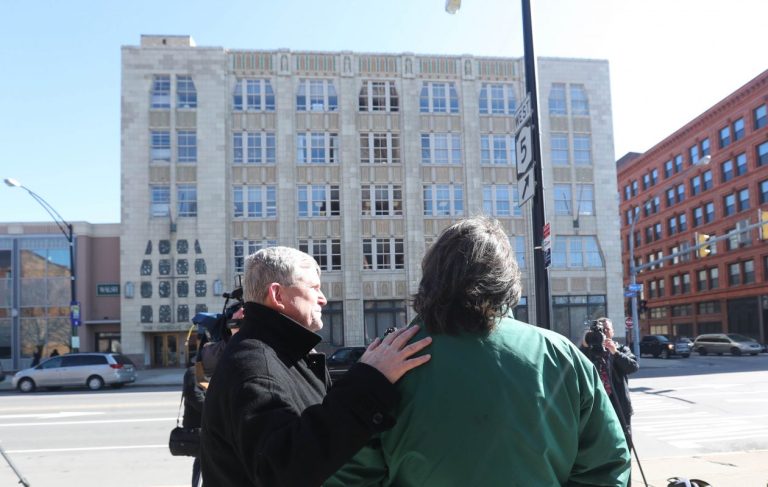
The Bishop was either at lunch or in a meeting when the press conference began. Since he was not in his office environs, I was able to slip into the small conference room adjacent to his office. The large window in the conference room gave me a clear view of the proceedings across the street.  On the windowsill was a large, wooden statue of St. John Neumann, the missionary saint who lived and ministered in WNY back in the 1800’s. He and I are both visible in the photo below if you look closely at the window on the 4th floor – one in from the corner – to the direct left of the Route 5 sign.

best view of me at window

Across the street in front of St. Louis Church, the mother church of the Buffalo Diocese, a gentleman in a green jacket was standing amidst news reporters and their cameras. He stood resolutely while he answered the many questions posed to him. I remember thinking, “How brave is this guy to stand up and speak about something so deeply personal and painful? I wish I could go over there to shake his hand and give him a hug.” After watching most of the press conference, I returned to my cubicle, but I could not shake that image of the man in the green jacket. It was only later that I would learn his name: Michael Whalen.

Within an hour or so of the conclusion of Michael’s press conference, the Chancery was in quite a state. The biggest question was how did “this Whalen fellow” know about the Bishop’s press conference? Had someone leaked the information regarding that event?! What were the chances that this victim would speak out two days before such a huge diocesan announcement? The conspiracy theories that were raised seemed too convoluted to me, so I just accepted it as a coincidence of epic proportions. I also noted that coincidence is simply another way of referring to God’s providence.

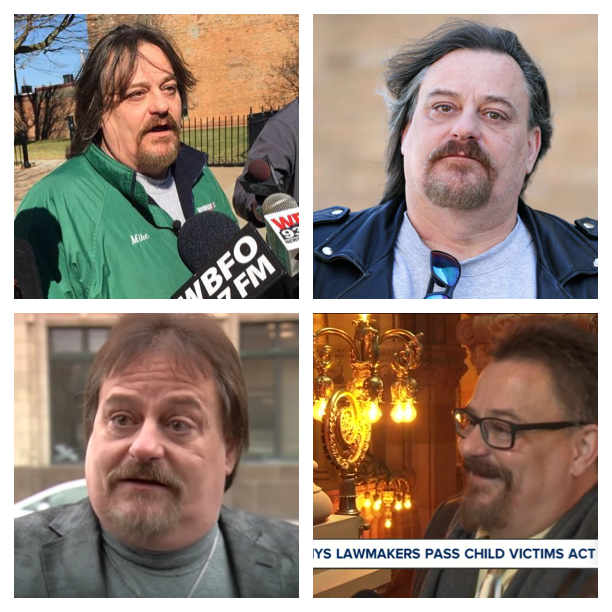
Michael Whalen could not have known the seismic impact his press conference would have. Any retrospective on the clergy abuse scandal in Buffalo must always begin with that February morning and the man in the green jacket. Michael stood up and spoke up before “clerical sexual abuse in Buffalo” was a search term that yields 2,690,000 results in 0.54 seconds. He spoke up before “Orsolits” was a household name in WNY. He spoke out before the McCarrick scandal brought clerical sexual abuse into the national spotlight once again. He spoke out before there were calls for Bishop Malone’s resignation and demands for accountability from all church hierarchy.

Michael’s bravery inspired many of his fellow survivors to come forward either in person or in print to share their stories of abuse and the cover-up. In the days, week and months that followed his February press conference, I would meet or speak with many of these courageous people. I will never forget their names, their faces or their voices. But it is Michael’s face that always pops into my head whenever I think of the Buffalo survivors. And it has been remarkable to watch how that face has changed over the past twelve months.

MW collage.png

As I watched this brave man over the past year, I began to feel as though I knew him. I watched every interview he did and loved seeing that he seemed to be gaining peace as the months went by. I loved his genuine answers to questions and the sincerity that shown through his eyes. His courage inspired me when it was my turn to speak out. Over the past year, I gained an ever greater appreciation for this hero of mine. But during this whole year, I never once met Michael.

Until February 27, 2019.

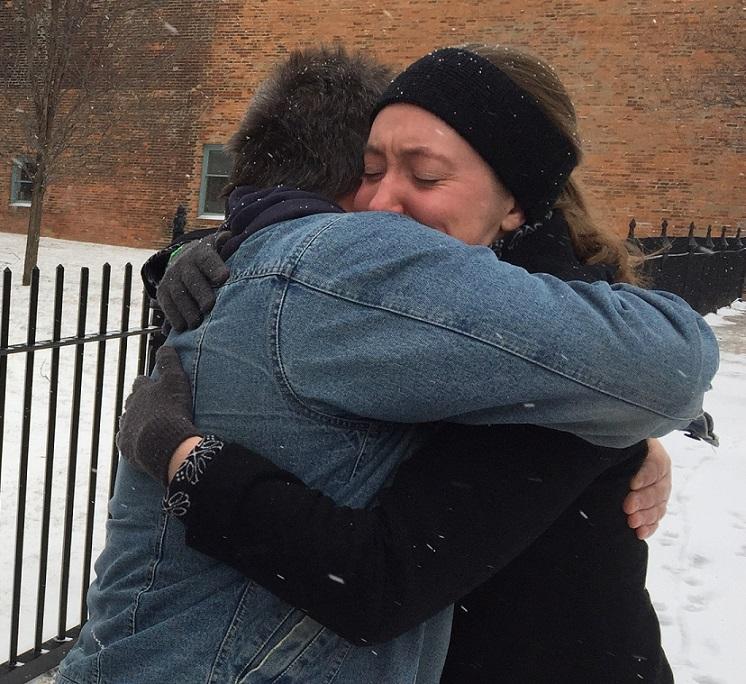
Today around noontime I walked up to St. Louis Church and shook Michael Whalen’s hand and gave him that hug.

hug

It was a surreal and beautiful experience to meet this real life hero whom I first viewed from a 4th floor window. I was also able to meet his lovely wife, Maria, who has shown heroic strength in supporting Michael throughout his journey. And, most amazing of all, the three of us walked into St. Louis Church to attend the 12:05 Mass.

For the past several months, Michael and I had talked about meeting each other. I had also shared with him the hope that he might eventually return to church as part of his healing journey. I could never have imagined how beautifully those two hopes would be fulfilled! As we neared this auspicious anniversary, it seemed most appropriate to meet on this date and at the location where Michael’s historic press conference took place. When I texted Michael to see what he thought of this idea, I was thrilled to receive his positive response. I knew that it would be Michael’s first time at Mass in many years, but I did not know just how long.

It was his first time attending Mass in 40 years.

It was an immense privilege to be there with Michael as he crossed the threshold of the church he’d stood in front of for multiple press conferences and interviews. It was a nearly indescribable joy to sit beside him as he attended Mass for the first time in four decades.

Forty is a very significant number within the Bible: Noah and his family survived after forty days and forty nights of rain. Moses did forty several times: years in Egypt and days on Mount Sinai. It took 40 years for the Jewish people to reach the Promised Land. Jesus’ fast in the desert lasted for forty days. According to Father Charles Grondin, “When we see the number forty used to denote time in the Bible, we are being told that something extraordinary and definitive is happening.”

Let me tell you, something extraordinary and definitive happened at St. Louis Church today! A very courageous man took an incredible step in his journey of healing. Before Mass, he spoke movingly about the beauty of the Catholic faith and how he never lost his faith in God. He spoke about how he is focused on healing and peace rather than hatred and pain. Michael expressed that he hoped attending today’s Mass would be a way for him to “start again.” How I hope and pray that will be exactly what happens for Michael.

Michael Whalen has taught me many things since I first glimpsed him from across Main Street. He has taught me that one person can make a difference. He has taught me that sometimes you have to speak up in order to see necessary change occur. He has taught me that courage is a way of life not a onetime deal. He has taught me that peace can be obtained even if the obstacles to that goal seem insurmountable. He has also reminded me that Jesus is always seeking us and waiting for us. His door is always open and He will always leave the (tabernacle) light on for you.

tabernal

Michael – may Jesus continue to lead and guide you on your journey of healing. May He preserve the beautiful peace that you exuded on this one-year anniversary. May your relationship with Him grow ever stronger as you continue to seek Him. May you always know of His immeasurable love for you. May you always know that He’s got the light on for you in any one of His churches.

Thank you, Michael Whalen. For being a hero. For being a trailblazer. For being you.


Remembering Flight 3407

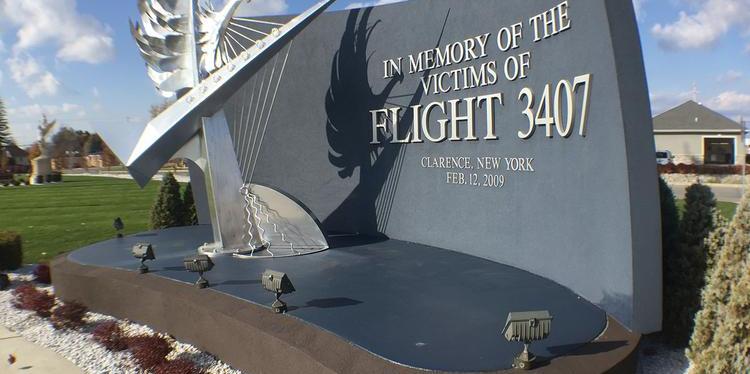
It was a cold February evening back in 2009. Typical Buffalo weather for that time of year… snowy, icy, chilly. When we heard the horrible news that a plane had gone down in Clarence, we could only assume it was a weather-related disaster. But that immediate assumption did not lessen the shock.

Buffalo had never experienced a plane crash of that magnitude – a commercial flight carrying 50 souls struck a house killing one person inside. We were stunned. 6308 Long Street – the address of the home that was struck – was less than 10 miles from the Buffalo airport! The plane and its passengers were achingly close to their destination. It was and is an immense tragedy, which was only increased when we learned that weather conditions were not the cause of the crash.

The effects of this tragedy were felt far and wide throughout our Western New York community. There was a palpable grief that lasted for many, many months. For the loved ones of those lost, that pain has never ended. I cannot fathom the suffering endured by those who still grieve their loved ones who perished that February night. Yet out of the ashes of their anguish, the families of Flight 3407 have become powerful advocates for much-needed improvements and changes to airline safety. Their tireless efforts have garnered high praise from none other than Captain Sully himself! They are incredible examples of how to deal with a tragedy in the most positive manner possible.

3407 names again

6038 long stret.jpg
Near the crash site is a place called Swormville – a hamlet in the eastern part of Amherst and the western part of Clarence. In case you’re wondering about it’s unusual name, the hamlet takes its name from Adam Schworm, a prominent landowner and businessman. The hamlet was originally known as Schwormville and is sometimes referred to as Swormsville. (Thank you, Google!) St. John Neumann, a great missionary saint who spent time in WNY, founded the “Parish of the Transit” that is now known as St. Mary’s Swormville.

At the time of the Flight 3407 crash, a young parochial vicar was assigned to St. Mary’s parish. His name? Father Bob Zilliox. Ordained in May of 2008, Father Bob’s first assignment was to St. Mary’s, which was under the pastoral leadership of Father Robert Yetter.

st mary's

Right after the crash of Flight 3407, Father Bob was eager to assist the community in healing from this tragedy. He approached his pastor, Father Yetter, about holding a Mass of remembrance for the victims of this tragedy and to offer consolation to their families and the grieving community. St. Mary’s is just 8 miles from the crash site and the closest Catholic Church. Unfortunately, Father Yetter was not interested in holding such a Mass and told Father Bob no. With great sadness, Father Bob watched as other Christian churches in the area held these much-needed services. He was distressed that his parish had not provided one as well.

Although Father Bob was assigned to St. Mary’s for three years, he spent only two years there. He was asked to pursue a degree in canon law since there was a need for additional canon lawyers in the diocese. With his naturally generous spirit, Father Bob embarked upon this new path on his priestly journey and ended up working for many years in the Buffalo Diocese’s Tribunal. Little did he know that he would eventually return to St. Mary’s.

During the late summer of 2018, St. Mary’s was reeling from the shock of alleged abuse perpetrated by their pastor, Father Yetter. Yetter was removed from ministry at the end of August and the parish found itself in need of a new pastor for the first time in over 20 years. But they were about to receive a great gift during this time of suffering: the return of the parochial vicar who had served them from 2008-2010.

Father Bob Zilliox was the perfect priest to be assigned to St. Mary’s – a parish in such great need of hope and healing. A victim of clerical sexual abuse himself, Father Bob was uniquely equipped to respond to the needs of his former parish. I have heard from many of his parishioners that despite their ongoing distress over their former pastor’s actions and the way Bishop Malone handled the situation, they are receiving great consolation and hope from Father Bob’s joyful presence among them.


One of the permanent deacons at St. Mary’s is Deacon Paul Snyder, who served with Father Yetter for 15 years. Deacon Paul was at the front lines of the response to the allegations against Father Yetter and was appalled at the Diocese’s lack of concern and care for the people of St. Mary’s parish. He became the first member and representative of the Diocese of Buffalo to call for Bishop Malone’s resignation. His strong, impassioned words on that final Friday of August 2018 will long be remembered.

May the Blessed Mother and St. John Neumann watch over and intercede for the priests, deacons and people of St. Mary’s Parish!

May the souls of those lost on Flight 3407 on February 12, 2009 rest in peace and may God console and strengthen their loved ones.

eternal rest by water

~ In loving memory of the victims of Flight 3407 ~

Passengers

  • Mary Abraham
  • David Borner
  • Linda Davidson
  • Ronald Davidson
  • Alison Des Forges
  • Beverly Eckert
  • John Fiore
  • Ron Gonzalez
  • Brad S. Green Sr.
  • Zhaofang Guo
  • Kevin Johnston
  • George Abu Karam
  • Sean Lang
  • Ellyce Kausner
  • Nicole Korczykowski
  • Jerome Krasuski
  • Brian Kuklewicz
  • Bethany Kushner
  • Maddy Loftus
  • Lorin Maurer
  • Donald McDonald
  • Coleman Mellett
  • Dawn Monachino
  • Dawn Mossop
  • Donald Mossop
  • Shawn Mossop
  • Jennifer Neill
  • Jennifer Neill’s Unborn Son
  • Gerry Niewood
  • Johnathan Perry
  • Mary Pettys
  • Ferris Reid
  • Julie M. Ries
  • John G. Roberts III
  • Kristin Safran
  • Jean Srnecz
  • Darren Tolsma
  • Susan Wehle
  • Ernest W. West
  • Shibin Yao
  • Clay Yarber

Crew

– Capt. Marvin Renslow, Pilot

– Rebecca Shaw, First Officer

– Matilda Quintero, Flight Attendant

– Donna Prisco, Flight Attendant

– Capt. Joseph Zuffoletto, off-duty crew member

6308 Long Street

– Doug Wielinski

blessed are they who mourn


A Hard-won Victory

Last week I was despondent about a bill passing into law in Albany.

This week I am delighted by a bill about to pass into law in Albany.

Such are the ups and downs of a pro-life, pro-victim New Yorker.

After fighting for the Child Victims Act for literally decades, survivors of child sexual assault can celebrate a hard fought, hard-won victory today. The New York State Senate unanimously passed the CVA as survivors and advocates looked on. In fact, Buffalo’s own Michael Whalen was there to witness this historic event.

Once signed into law, the CVA allows victims of child sexual abuse to file a civil lawsuit against their abuser and pertinent institutions until they are 55 years old. Previously, victims were only able to sue until they turned 23.

In addition, the Child Victims Act includes a “look back window,” which allows adult victims to sue during a one-year period. Before this law, such action by these individuals was prevented by the statute of limitations. Another important point is that law enforcement will now have additional time to file charges against abusers.

As you likely know, the Catholic Church in New York State has long opposed this law. The eight Catholic bishops of New York State have collectively spent millions lobbying against this legislation. (Buffalonians may recall that on the day the original list of 42 priests was released last year, Bishop Malone was in Albany lobbying against the CVA among other things. The optics were really bad for the Diocese of Buffalo that week.) The bishops’ opposition has gradually eased over the last year most likely as a result of the clerical sexual abuse scandal currently playing out within the Church. As episcopal cover-ups and complicity have become more clear, the bishops’ opposition began to dwindle as well it should.

One important point that the bishops always raised was that public institutions should be included in this bill along with private organizations. I heartily agree with them in this regard. After all, a victim is a victim. Abuse is abuse. Just as it shouldn’t matter when the abuse occurred, it shouldn’t matter where or by whom: a public school teacher, a priest, a Boy Scout troop leader, a guidance counselor, a deacon, etc. – any and every abuser should be held accountable. As far as I know, today’s legislation incorporated the provisions demanded by the Catholic bishops. I’d call that a win-win.

It is important to recognize that this law may have a dramatic impact on the Catholic Church in New York State. Before today, this “look-back window” had been instituted in only 4 states: California, Delaware, Hawaii and Minnesota. Multiple dioceses in those states have filed for bankruptcy after paying large sums to victims. This is not a pleasant prospect for Catholics, but it is wise to be prepared for such an occurrence. While there is no fully adequate earthly justice for what survivors have endured, they deserve every bit of that justice they can obtain.

This is where the Independent Reconciliation and Compensation Program comes into play. Most of the dioceses in New York – including Buffalo – have initiated such a program. Survivors who participate in the program and agree to the compensation they receive also waive their right to sue. According to various news sources, it would seem that the majority of participating survivors in NYS have signed the “I won’t sue” release.

However, there are survivors who have decided to pursue a civil lawsuit. Cynics will say they’re looking for a larger dollar amount. From my experience, this is not an accurate description. Most survivors are not focused on the financial aspect, but rather on their personal quest for truth and justice. If their quest is best pursued through a jury trial rather than an IRCP judge’s decision, that is their choice. I support survivors no matter which route they choose. I just pray that whichever path they select, it will bring them as much peace and healing as possible. Money cannot heal, but it can help.

I would be remiss if I did not mention adult victims of clerical sexual abuse. While today’s legislative victory marks a long-awaited milestone for child victims, it is a reminder that there is still work to be done in fighting for justice for adult victims of clerical sexual abuse. While we celebrate today’s victory, let us not forget the many adult victims who are still waiting for justice and truth.

Finally, I love this “survivor psalm” and wish I knew its author so that I could give proper credit. To me, these words eloquently express not only the anguish and agony of survivors, but also their ability to rise about their suffering. Their resiliency never fails to inspire me.

surivor-psalm-e1548715340486.jpg


Life Lessons from Nana

nana and i motorcycles

When it comes to my Nana, it’s hard for me to adequately describe three things: how amazing she was, how much I love her and how much I miss her. Ellen Christina Quigley was born on January 25, 1919 and returned to her Creator on October 1, 2012. The greatest honor of my life will always be that I am my Nana’s granddaughter. Through the tears of missing her on what would have been her 100th birthday, I thank God for the immense and enduring gift of her life.

Perhaps I should start by explaining the photo that begins this post. Not surprisingly, it is my favorite photo of all time. During the fall of 2008, I had the privilege of living in my Nana’s hometown of Beverly, MA in order to care for her every day. This was a tremendous gift as my family has always lived at least 400 miles from our nearest extended family. I still can’t believe how fortunate I was to spend three months in the daily presence of my favorite human being. She had total cognitive function, but needed help with staying safe while going about her day. So obviously motorcycles were in order!

We had just finished lunch at Kelly’s, a roast beef sandwich spot akin to Anderson’s in Buffalo. Upon exiting the restaurant doors, we saw these two motorcycles parked right next to my Civic. Nana gave them an admiring appraisal and exclaimed, “Would you look at those motorcycles!” Nana went over to the blue bike and began inspecting it more closely. At this propitious moment, the owners of the bikes emerged from the restaurant. They were far from the stereotypes of my imagining: two diminutive women whose motorcycle ownership was only evidenced by the helmets in their hands. Fortunately, they seemed amused to find us so close to their bikes with Nana literally getting up in one’s grille. Upon realizing their presence, Nana looked up and cheerily introduced herself. Both women were charmed by her, as everyone always was, and introduced themselves in return. It turned out that the owner of the blue motorcycle was also named Ellen. And so it happened that Nana and I got a chance to pose on the motorcycles with Nana eagerly donning Ellen’s proffered helmet.

After the photo was taken, the ladies asked us if we’d like them to take us on a little spin around the parking lot. Nana’s immediate answer was an enthusiastic “Yes!” It was obvious that the motorcycle ladies had just met their new hero. I can still remember Nana’s eyes twinkling over the mouth guard of her helmet. At the same time, I could imagine my mother and my aunts’ eyes if they learned of any Nana/motorcycle escapades I had authorized or participated in. It was oh so very hard to remind myself that I was Nana’s caretaker and couldn’t be her fellow thrill seeker. Nana was very cute when I told her that we’d need to watch from the sidewalk as our new friends rode off: “It’s okay. She wouldn’t let me get a henna tattoo at the fair either.” The motorcycle ladies were still laughing as they waved to us from the road.

We see the mantra often: Live life to the fullest. So easy to say, but rather difficult to do. My Nana lived her life so fully that she had extra life left over that seemed to spill from her in bursts of enthusiasm and joy. She was always up for anything and often surprised us with her zest for life. One time we were passing Fenway after she was discharged from a Boston hospital after a week-long stay. Nana instantly realized that the Red Sox were playing an afternoon game. She immediately checked her watch: “Game probably started at 1:05. If we can get a reasonable parking spot, they might let us in cheap and we could catch 4 or 5 innings.” This elderly woman had just been through a lengthy and depleting hospital stay yet she was more than up for the chance to root for the home team.

Nana lived through the Great Depression, a World War and many other dramatic world events. She raised 5 children while holding a demanding job to help support her family, which never enjoyed financial comfort. She was a natural athlete who excelled at and thoroughly enjoyed every sport she tried. She had a can-do attitude that did not permit pessimism. In her presence, you felt that anything was possible and the world was a brighter place than you previously thought it was.

Among the many lessons my Nana taught me, the foremost one is to love people. Nana just loved people – family, friends, neighbors, strangers, etc. She would truly do anything for a person in need while thinking little and always last of herself. She wanted to know how people were doing and she really listened when they told her. She remembered people’s names with such acuity that it often startled them. She looked for the good in people and was not surprised when she found it. In turn, people adored my grandmother. It could be time-consuming to grocery shop with her. Not because of any mobility issues on her part, but because everyone we passed in the aisles would want to talk to her whether they knew her or not. She was just the sweetest thing. Nana loved people and how they loved her in return! When we took her to West Beach near her coastal hometown, the parking lot attendant would sound the call: “Ma Quigley’s here – make way!” and you would think the Queen of Something had arrived.

Less than 10 years before we lost her, one of my cousins conducted an interview with Nana. I’m so grateful that he did this because her answers are such a lasting gift to us. My favorite is the following Q&A:

What advice can you give me that would help me to live a happy and successful life?

Study. Gain as much knowledge as you can. You never know when it will come in handy. Keep your mind on your work and retain as much of the information as possible. Be honest with yourself and others. Live a good life and live your faith. Follow the Golden Rule. Appreciate yourself for who you are. You know what is right – don’t stray from that. Just do it. Keep company with the right kind of people. Value your life – don’t let yourself down.

These words of wisdom continue to inspire me. Last summer, I thought of my Nana’s advice when I was wrestling with the idea of leaking diocesan documents. I tried to imagine what she would say if I could ask her what I should do about my dilemma. Then I could almost hear her saying, “You know what is right… just do it.” So I did.

NANA & Me.jpg

Thank you, Nana, for all that you taught me and the innumerable, literally heartwarming memories I have of you. I miss you more than I can say, but I can’t wait to see you again in the life that will never end. I always loved it when you’d call me “your darling girl.” My darling Nana, I love you!

beverly salem

In an interesting twist that proves life is never boring, Bishop Malone was born in Salem, Massachusetts, which is the closest geographic neighbor of Beverly, my Nana’s hometown. In fact, they’re so close that there is a Beverly-Salem bridge that crosses the slender river separating the two towns. Bishop Malone was raised in the same parish – St. Mary, Star of the Sea – at which my Nana and my mother received all of their Sacraments. It was a neat experience to share this connection with my bishop and my boss. Sometimes he would talk about his hometown region and would mention a spot such as the Beverly Depot. I would smile and say, “Oh yes, over on Rantoul Street!” He would do a double take to hear such a unique street name uttered so familiarly by a Buffalonian. I would tease him just a little when fatigue would lead him to drop a couple “R’s” from his speech as a native Beverly/Salemite is wont to do. For Christmas the first year I worked for him, I gave the Bishop a few “Cat’s Meow” pieces of iconic Beverly buildings such as St. Mary’s itself.

st mary church

He placed it on an end table near the “Distinguished Alumni Award” that St. Mary’s School gave him in 2009. I would smile when I saw it as I turned on and off his office lights every day. I thought it was so cool to have Beverly in common with the Bishop.

It’s a little less cool these days, I must admit. I cringed when I realized that the Red Sox had a chance to win the World Series on Sunday, October 28th for that was the night when the 60 Minutes episode about our diocese would air. I clearly remembered how all through that summer, Bishop Malone had eagerly watched as many games as he could. He is a true baseball fan who knows all the stats and watches games all the way through. He was very hopeful that the team would have a long season and win it big come autumn. I never root against my Nana’s beloved baseball team*, but I was hoping the Dodgers would win on October 28th so that the Red Sox could win the World Series on another night. Instead, the Sox won it 5-1 that evening. At the press conference I held two days later, I apologized to Bishop Malone for one thing only: ruining the World Series for him. I was happy that they’d won for him and for my Nana, but the timing was rough.

How I wish that I could share my Nana’s advice with Bishop Malone at this time:

You know what is right – don’t stray from that. Just do it. 

Praying for you, Bishop Malone. Don’t let yourself down.


*Lest any of my fellow Buffalonians worry, I do not root for my grandmother’s other teams: the Bruins or the Patriots. Over the years, I often debated with Nana about Tom Brady and his henchmen. For such a sweet lady, she sure could talk some serious smack!